
Industrial Waterproof Connector for Reliable Equipment Connections-医疗行业新能源行业通讯行业工控设备机器人行业照明行业产品知识媒体报道公司新闻常见问题答疑产品基础知识连接器选型产品证书宣传资料安装视频安装流程书三维图产品规格书防水接线端子储能连接器防水接线盒数据连接器电源连接器信号连接器Waterproof Cable ConnectorEnergy Storage ConnectorJunction BoxData ConnectorSignal ConnectorPower ConnectorMedical IndustryNew Energy IndustryCommunications IndustryIndustrial Control EquipmentRobotics IndustryLighting IndustryFAQProduct BasicsConnector SelectionProduct CertificatePropagandaInstallation VideoInstallation Procedure BookThree Dimensional MapProduct SpecificationsProduct KnowledgeMediaCompany NewsPV ConnectorCable GlandLighting Connector
Industrial equipment rarely operates in a perfectly controlled environment. Machinery installed on production lines, processing equipment, automation systems, outdoor cabinets and mobile platforms can be exposed to moisture, dust, vibration, cable movement and temperature changes. At the connection point, these conditions can directly affect electrical reliability.
This is where an industrial waterproof connector becomes an important part of the equipment design. A properly selected connector helps protect the electrical interface while providing a practical connection between cables, sensors, control devices and other electrical components.
For equipment manufacturers, system integrators and industrial procurement teams, connector selection should not be based on waterproof performance alone. The cable specification, mounting method, electrical requirements, mechanical stress and required certifications also need to match the application.
Why Waterproof Connectors Matter in Industrial Equipment
A connector creates a physical interface between electrical circuits. In an industrial environment, that interface may be located outside an enclosure or at a point where cables enter the equipment.
If moisture, dust or contaminants reach the connection area, they can affect electrical performance and contribute to corrosion or insulation problems over time. Mechanical stress can create another failure point when cables are continuously pulled, bent or exposed to vibration.
An industrial waterproof connector is designed to address these environmental challenges through a combination of connector housing, sealing components, cable retention and contact design.
The objective is not simply to make the connector waterproof. The complete connection needs to remain suitable for the actual operating conditions of the equipment.
Industrial Applications for Waterproof Cable Connections
Waterproof connectors are used across a wide range of industrial equipment where protected cable connections are required.
Industrial Automation Equipment
Automation systems can include sensors, actuators, motors, control units and monitoring devices. These components may be connected through multiple cable interfaces, making reliable connections important for continuous machine operation.
Depending on the equipment architecture, an industrial waterproof connector can be used for sensor connections, control wiring, power interfaces or external cable connections.
Factory and Production Machinery
Production equipment can operate continuously for long periods and may be exposed to dust, lubricants, cleaning processes or mechanical vibration.
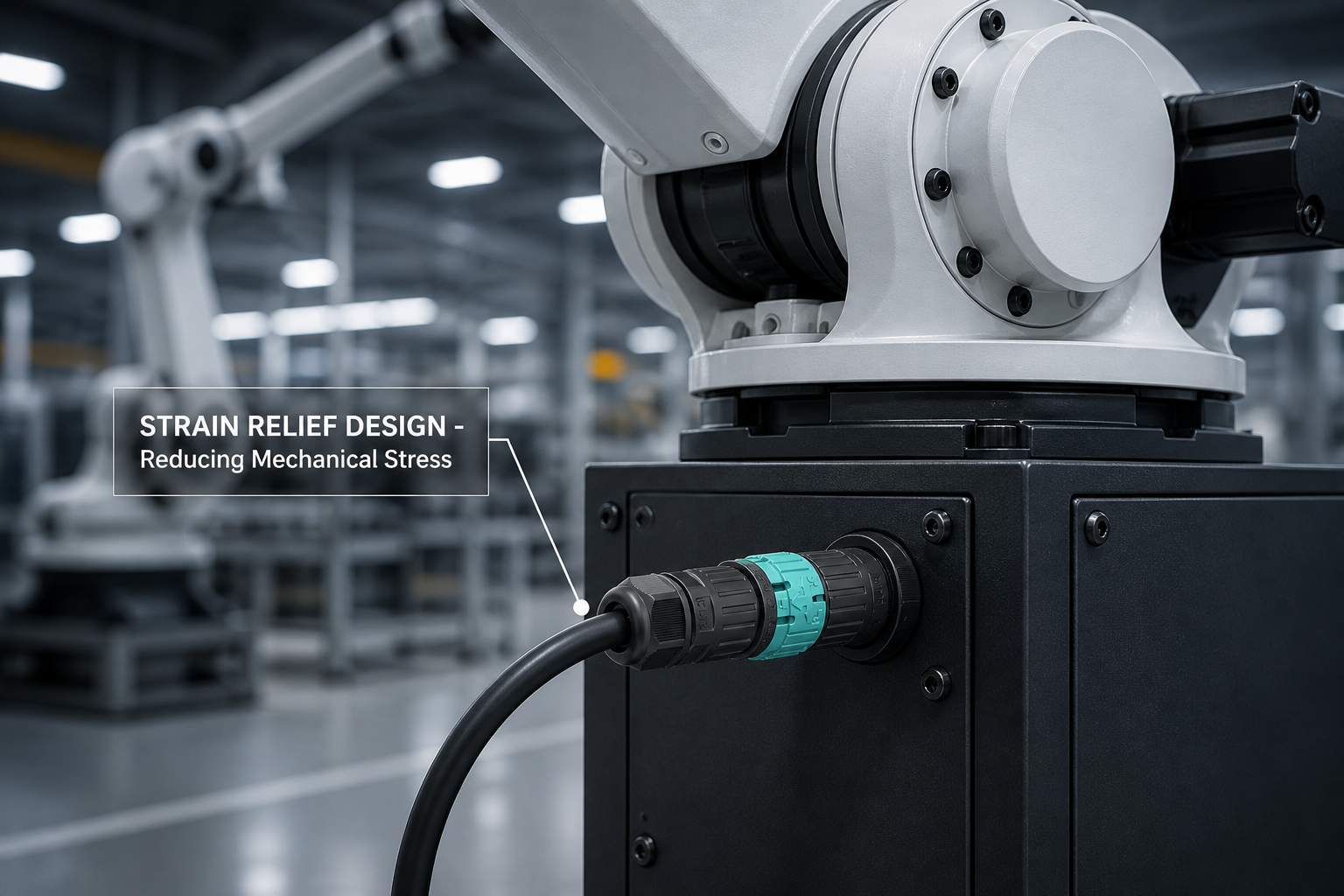
For machines installed in these environments, connector selection should consider both environmental protection and mechanical installation. Cable routing and strain relief are particularly important when the connection is located close to moving equipment.
Outdoor Industrial Equipment
Outdoor equipment faces additional environmental exposure, including rain, humidity, condensation, dust and temperature fluctuations.
In these applications, a connector with an appropriate IP protection rating can help protect the connection interface from environmental ingress. The exact rating should be selected according to the equipment's installation conditions and applicable test requirements.
Mobile and Robotic Equipment
Mobile platforms and robotic equipment introduce another challenge: repeated cable movement.
Even when the connector provides a high level of ingress protection, excessive cable pulling or bending can place mechanical stress on the connection. For this reason, connector selection should be considered together with cable routing, support points and strain relief.
Understanding IP67 and IP68 Protection
IP protection is one of the first specifications engineers often check when selecting an industrial waterproof connector.
IP67 and IP68 are commonly considered for applications requiring protection against dust and water ingress. However, the two ratings should not be treated as interchangeable marketing terms.
IP67 generally indicates protection against dust ingress and temporary immersion under specified test conditions.
IP68 indicates protection against dust ingress and water ingress under immersion conditions specified for the product and applicable test method. The exact conditions should therefore be checked in the manufacturer's technical documentation.
For selected E-Weichat waterproof connector series specified with an IP68 rating, buyers should confirm the exact model, cable diameter range, installation method and applicable test conditions before approving the component for production.
This is important because an IP rating describes a defined level of ingress protection. It does not automatically indicate resistance to vibration, chemicals, UV exposure, repeated bending or every other environmental condition.
Why Cable Diameter Matters to Waterproof Performance
The connector and cable form a complete connection system. One of the most commonly overlooked specifications is cable outer diameter.
Many waterproof cable connectors use a sealing structure around the cable. The sealing element must work within the specified cable diameter range to provide the intended environmental protection.
Before selecting an industrial waterproof connector, engineers should confirm:
- Cable outer diameter
- Number of conductors
- Conductor cross-section
- Cable jacket material
- Cable flexibility
- Operating temperature
- Required voltage and current
This becomes especially important when an OEM changes cable suppliers. Two cables with similar appearance may have different outer diameters, jacket materials or flexibility characteristics.
For production applications, the connector should therefore be qualified with the actual cable specification rather than relying only on a nominal cable size.
Mechanical Stress and Connector Reliability
Environmental sealing is only one part of industrial connector reliability.
Mechanical stress can also affect the connection. Industrial machinery may generate continuous vibration, while robotic systems can subject cables to repeated movement.
If the cable is unsupported, its weight and movement can transfer force directly to the connector. Over time, this can create unnecessary stress around the cable entry point.
A practical installation should therefore consider:
- Cable routing
- Strain relief
- Vibration level
- Cable bending radius
- Connector orientation
- Available installation space
The connector should provide the electrical and environmental interface, while appropriate cable support should manage mechanical loads wherever necessary.
Choosing the Right Connection Configuration
Industrial waterproof connectors are not limited to one installation configuration. The appropriate design depends on the equipment structure.
Cable-to-Cable Connection
A cable-to-cable waterproof connector can be used when two cable assemblies need to be joined directly. This configuration is useful for external wiring, equipment extensions and applications where a detachable cable connection is required.
For these applications, engineers should check cable compatibility, connector dimensions, locking structure and sealing requirements.
Panel Mount Connection
A panel mount waterproof connector is suitable when the electrical interface needs to be integrated directly into an equipment enclosure.
In addition to the connector's front-side dimensions, engineers should check the mounting hole, panel thickness, rear clearance and cable bend radius.
A connector may fit the mounting hole but still be unsuitable if there is insufficient space behind the panel for cable routing or maintenance.
Electrical Requirements Should Be Defined First
Waterproof protection does not replace electrical qualification.
Before selecting an industrial waterproof connector, the equipment designer should define the electrical requirements of the connection.
- Rated voltage
- Rated current
- Number of contacts
- Contact configuration
- Signal or power application
- Cable specification
- Required insulation performance
Power connections, sensor interfaces and signal connections can have different requirements. A connector that is suitable for one application should not automatically be assumed to be suitable for another simply because the physical dimensions are similar.
Locking Design for Industrial Environments
Connection retention becomes increasingly important when equipment operates under vibration or movement.
A suitable locking structure helps maintain the intended mating condition during operation. Depending on the connector design, this may include threaded locking, bayonet-style locking or another mechanical retention structure.
For engineers, the locking mechanism should be evaluated according to vibration level, installation space, maintenance frequency and expected connection cycles.
For equipment that requires regular service, the locking structure should also be practical for technicians to operate during installation and maintenance.
Material Selection for Industrial Waterproof Connectors
The connector housing and sealing components need to be compatible with the operating environment.
Depending on the application, the connector may be exposed to moisture, temperature variation, dust, oils, cleaning agents or outdoor conditions.
IP68 protection should therefore not be interpreted as a general material-resistance specification. If the connector will be exposed to a specific chemical or cleaning agent, the relevant material compatibility should be reviewed separately.
For outdoor applications, UV exposure and temperature changes may also need to be considered during product selection.
Certification and Quality Documentation
Industrial OEMs and system integrators often require technical documentation during supplier qualification.
Depending on the project, buyers may request product specifications, test reports, material information, IP test documentation and applicable certification records.
Where TUV certification is a project requirement, buyers should review the relevant TUV documentation against the exact connector series or model being considered. This provides a more reliable basis for supplier qualification than relying on a general certification statement.
The same approach should be used for IP ratings and other technical specifications. The exact product configuration matters.
What Engineers Should Include in a Connector RFQ
A detailed RFQ can significantly reduce communication time between the engineering team, procurement department and connector manufacturer.
Instead of simply requesting a waterproof connector, provide the application information.
- Application type
- Indoor or outdoor installation
- Required IP rating
- Cable outer diameter
- Number of contacts
- Voltage and current
- Power, signal or data application
- Cable-to-cable or panel mount configuration
- Operating temperature
- Vibration or cable movement conditions
- Required certifications
- Estimated annual quantity
This information allows the connector supplier to evaluate the application more accurately and recommend a suitable configuration.
Common Mistakes When Selecting an Industrial Waterproof Connector
Choosing the Highest IP Rating Without Checking the Application
A higher IP rating is not automatically the best solution. The required protection level should correspond to the actual environmental conditions and applicable testing requirements.
Ignoring the Cable Outer Diameter
The connector sealing system must match the specified cable diameter range. An incompatible cable can affect the intended sealing performance.
Assuming IP68 Covers Every Environmental Risk
IP68 addresses defined ingress protection conditions. It does not automatically guarantee chemical resistance, vibration resistance, UV durability or electrical compatibility.
Ignoring Mechanical Loads
Vibration and cable movement can create mechanical stress even when the connector has suitable environmental protection. Proper cable support and strain relief should be included in the installation design.
Checking Only the Connector and Not the Complete Assembly
The connector, cable, enclosure and installation method work together. Qualification should consider the complete connection rather than the connector body alone.
E-Weichat Industrial Waterproof Connector Solutions
E-Weichat develops waterproof connector solutions for industrial equipment, outdoor applications, energy systems, lighting and other environments where protected cable connections are required.
Selected E-Weichat waterproof connector series are specified with IP68 protection and are designed for applications requiring a secure cable interface in demanding environments.
For projects requiring TUV certification, the applicable documentation should be reviewed according to the selected product series and model.
For OEM customers and industrial equipment integrators, E-Weichat can evaluate connector requirements based on the application, cable specification, mounting configuration and electrical requirements.
Providing these details at the beginning of a project helps reduce unnecessary product substitutions and makes it easier to identify a connector configuration suitable for the equipment.
A Practical Approach to Industrial Connector Selection
The most reliable way to select an industrial waterproof connector is to start with the operating conditions rather than the connector catalog.
First, define where the equipment will operate.
Next, determine the cable specification and electrical requirements.
Then evaluate mechanical stress, installation space and maintenance requirements.
After these requirements are clear, select the appropriate connector configuration and verify the IP rating, test conditions and certification documentation for the exact model.
This application-based approach helps engineers avoid a common problem in industrial equipment design: selecting a connector that looks suitable on paper but does not match the complete installation environment.
Frequently Asked Questions
What is an industrial waterproof connector?
An industrial waterproof connector is a connector designed to provide a protected electrical connection in environments where exposure to moisture, dust or other environmental conditions may occur. The appropriate connector should be selected according to its electrical, mechanical and environmental requirements.
Is an IP68 connector suitable for outdoor industrial equipment?
An IP68 connector can be suitable for outdoor equipment where a high level of dust and water-ingress protection is required under specified conditions. The exact connector model, cable diameter, installation method and environmental exposure should be verified before use.
What information should I provide when sourcing an industrial waterproof connector?
Provide the application, environment, required IP rating, cable outer diameter, contact configuration, voltage, current, mounting method, operating temperature, mechanical conditions and certification requirements. These details allow the supplier to recommend a more appropriate connector configuration.
Advantages
-

Fast and Convenient
-
Customization
Related products
Partner






Hot Promoted Products
National Service Hotline
9:00-21:00 (Monday to Sunday, excluding statutory holidays)
Links: