
Signal Waterproof Connector for Outdoor Communication Equipment-Communications Industry
Outdoor communication equipment has to maintain stable signal connections while operating in environments that are very different from a controlled indoor installation. Telecom cabinets, wireless communication equipment, remote network devices and outdoor monitoring systems may be exposed to rain, humidity, dust, temperature changes and continuous mechanical vibration.
For engineers designing these systems, the cable interface is an important part of the overall connection architecture. A cable may have suitable electrical characteristics, but if the connection point is poorly protected or difficult to maintain, the complete system can still face unnecessary installation and maintenance issues.
A Signal Waterproof Connector is designed to provide a protected interface for signal cables in applications where environmental exposure needs to be considered. The connector must not only provide the required electrical connection but also match the cable, enclosure, installation method and environmental conditions of the communication equipment.
This application case examines how signal waterproof connectors can be used in outdoor communication equipment and what telecom equipment manufacturers, system integrators and procurement teams should evaluate before selecting a connector.
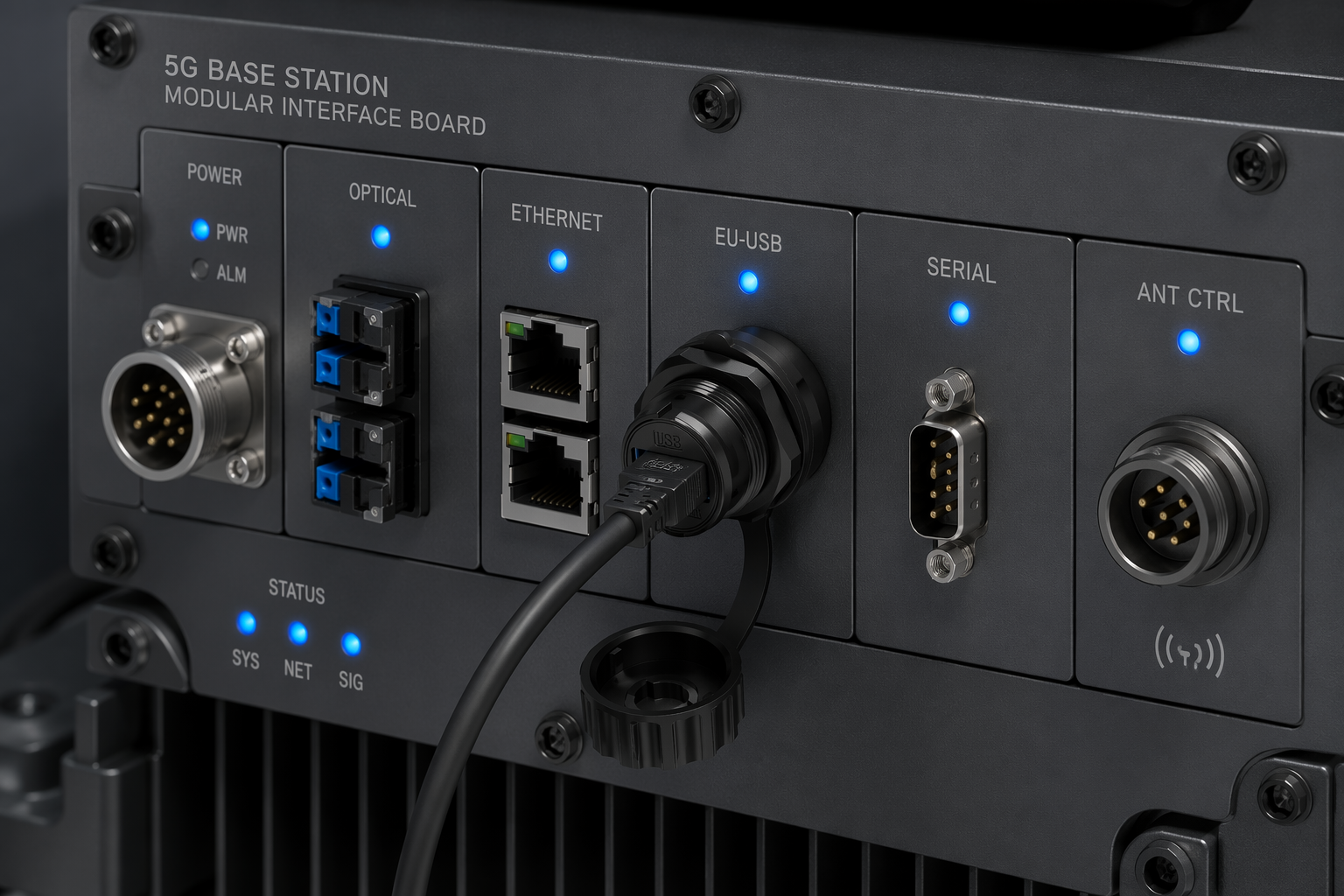
Why Signal Connections Need Environmental Protection
Signal connections are often installed at the boundary between an electronic enclosure and the external environment. This makes the connector a potential entry point for moisture and contaminants if the interface is not appropriately designed.
Outdoor communication equipment can encounter:
- Rain and water exposure
- High humidity and condensation
- Dust and airborne particles
- Repeated temperature changes
- Equipment vibration
- Cable movement during installation and maintenance
- Long periods without direct service access
These conditions are particularly relevant to equipment installed on communication towers, outdoor cabinets, industrial sites, remote monitoring locations and other exposed environments.
A suitable waterproof signal connector can help create a controlled connection point between the external cable and the protected equipment enclosure.
Application Case: Signal Connections in Outdoor Telecom Equipment
Consider an equipment manufacturer developing an outdoor communication unit. The enclosure contains electronic modules responsible for signal processing and communication functions, while several cables need to be connected externally.
The engineering team needs a connector that can provide a stable signal interface while helping protect the cable entry point from the surrounding environment.
The project requirements may include:
- Reliable signal transmission
- Environmental sealing
- Secure cable retention
- Compatibility with the selected signal cable
- Resistance to normal equipment vibration
- Practical installation and maintenance
- Consistent assembly across production units
In this situation, a Signal Waterproof Connector is not simply a cable joining component. It becomes part of the mechanical and environmental interface of the communication equipment.
IP68 Protection for Demanding Outdoor Applications
For outdoor communication equipment requiring a high level of protection against dust and water ingress, an IP68 signal waterproof connector can be evaluated.
IP68 is particularly relevant when the connector is installed in a location where exposure to moisture and dust cannot be avoided. However, the IP rating should always be reviewed against the exact connector model and its specified test conditions.
The protection performance of a completed cable connection can depend on several factors, including:
- Connector sealing structure
- Compatible cable outer diameter
- Correct installation
- Proper mating of the connector
- Correct use of sealing components
- Installation position and environmental conditions
An IP68 rating therefore should not be interpreted as meaning that every installation will automatically achieve the same level of protection. Engineers should verify the product documentation and installation requirements for the selected model.
For E-Weichat waterproof connector solutions specified as IP68, the applicable rating should be evaluated according to the relevant product specifications and test conditions for the exact model.
Signal Protection Is More Than Waterproofing
One common mistake in communication connector selection is focusing only on environmental protection while overlooking the electrical characteristics of the signal connection.
A connector used for communication equipment needs to be matched to the signal requirements of the system. Depending on the application, engineers may need to consider contact configuration, operating voltage, current, cable construction and other electrical parameters.
For higher-frequency or data-sensitive applications, the connector interface can also become part of the overall signal path. In these cases, connector selection should be based on the electrical characteristics specified for the particular system rather than assuming that every waterproof connector is suitable for every communication signal.
Check the Cable Before Selecting the Connector
The connector and cable should be evaluated as a complete interface.
Important cable information may include:
- Cable outer diameter
- Number of conductors
- Conductor size
- Signal type
- Operating voltage
- Operating current
- Required bending characteristics
For a signal cable waterproof connector, cable compatibility is particularly important because the sealing structure needs to accommodate the specified cable dimensions.
Why Secure Cable Retention Matters in Telecom Equipment
Outdoor communication equipment may remain in service for long periods. During installation, however, cables can be pulled, repositioned or bent repeatedly.
If mechanical stress is transferred directly to the electrical connection, it can create unnecessary strain around the connector and cable termination.
This is why strain relief and cable retention should be considered during connector selection.
A suitable strain relief structure can help manage mechanical forces around the cable entry area. The connector should also be installed according to the manufacturer's recommended cable range and assembly procedure.
Vibration in Outdoor Communication Systems
Vibration can come from equipment cooling systems, nearby machinery, moving structures or environmental conditions. Communication equipment installed on towers or industrial structures may also experience mechanical movement that is not present in an indoor cabinet.
The connector's mating structure should therefore be appropriate for the expected application.
Depending on the design, a threaded or locking connection can help maintain a secure interface after installation. The correct connector structure depends on whether the application requires frequent disconnection or long-term fixed installation.
Connector Installation on Communication Enclosures
Many outdoor communication systems use metal or polymer equipment enclosures. External cables enter the enclosure through defined connection points, making panel and enclosure compatibility an important part of the connector selection process.
Before selecting a panel mount signal connector, engineers should confirm the available installation space and mounting dimensions.
Key factors include:
- Panel thickness
- Mounting dimensions
- Connector body size
- Rear clearance
- Cable bend space
- Spacing between adjacent connectors
A connector may fit the external panel while still leaving insufficient space for cable routing inside the enclosure. Reviewing the complete installation geometry during the design stage can reduce assembly problems later.
Outdoor Temperature Changes Should Be Included in the Design
Outdoor telecom equipment may experience significant temperature changes between daytime and nighttime operation. Seasonal temperature variation can create an even wider operating range.
The connector, sealing materials and cable should therefore be evaluated against the operating temperature requirements of the equipment.
Engineers should review the specified temperature range of the exact connector model rather than relying on a general statement that a product is suitable for outdoor use.
Material compatibility is also worth considering when the connector will remain exposed to the environment for an extended period.
Maintenance Access Is an Engineering Consideration
Outdoor communication equipment is not always easy to access. Equipment may be installed on elevated structures, remote sites or distributed network locations.
This makes maintenance time an important consideration during connector selection.
A connection that is difficult to access or disconnect can increase service time when a cable or external module needs to be replaced.
For telecom equipment manufacturers and system integrators, the connector should therefore be evaluated not only for initial installation but also for potential field maintenance.
Questions for Maintenance Planning
- Can technicians access the connector after installation?
- Can the cable be disconnected without removing the entire enclosure?
- Is the mating mechanism practical for service work?
- Can replacement cables be installed consistently?
- Does the connector require special installation tools?
These details may have little effect on the initial component price but can become important over the equipment's service life.
Certification and Technical Documentation
Professional communication equipment manufacturers often require technical documentation during supplier qualification.
Where TUV certification is required for a project, buyers should verify the certification documentation for the exact connector series or model being evaluated.
Certification should not be assumed to apply automatically to every connector within a manufacturer's product portfolio. The applicable product model, standard, test conditions and documentation should be confirmed during technical evaluation.
The same approach should be applied to IP ratings, electrical specifications, material information and other technical parameters.
For B2B procurement teams, model-specific technical documentation provides a clearer basis for supplier qualification and product comparison.
How to Select a Signal Waterproof Connector
A practical selection process should begin with the communication equipment rather than the connector catalog.
1. Define the Signal Requirements
Identify the type of signal, number of contacts and electrical requirements of the interface. For data-sensitive applications, verify that the selected connector is appropriate for the required signal characteristics.
2. Confirm Cable Dimensions
Provide the cable outer diameter, conductor configuration and other relevant cable specifications. This is particularly important for the connector sealing system.
3. Define the Outdoor Environment
Consider exposure to rain, humidity, dust, vibration and temperature variation. The environmental conditions should determine the required protection level.
4. Select the Appropriate IP Rating
Where high protection against dust and water ingress is required, an IP68 solution can be evaluated when the exact product specification supports the application.
5. Review Mechanical Requirements
Consider strain relief, cable routing, expected vibration and the connector's locking or mating structure.
6. Check Enclosure Compatibility
Verify panel thickness, mounting dimensions, rear clearance and cable bend space before finalizing the connector design.
7. Confirm Documentation
Review applicable certifications, test reports and product specifications for the exact model before supplier approval.
From Telecom Equipment Design to Field Installation
A signal connection has to work through several stages of the product lifecycle. It needs to be practical for factory assembly, compatible with the equipment enclosure, suitable for field installation and appropriate for the environmental conditions expected at the installation site.
This is why connector selection should involve engineering, manufacturing and procurement teams rather than being based only on a component's appearance or unit cost.
For equipment manufacturers producing multiple models, standardizing suitable connector families can also simplify purchasing and assembly. However, standardization should be based on defined technical requirements rather than assuming that one connector configuration is suitable for every communication application.
Why the Connector Should Be Considered Part of the Signal Interface
In communication equipment, the connector sits at the boundary between the cable and the electronic system. It therefore has both an electrical and mechanical role.
The electrical requirements determine whether the connector is appropriate for the intended signal application. The mechanical and environmental requirements determine whether the connection can be properly installed and protected in the intended environment.
A suitable Signal Waterproof Connector should therefore be selected by considering these requirements together.
For outdoor applications, an IP68-rated connector may be appropriate where the required protection level calls for high resistance to dust and water ingress. Strain relief and secure mating can help address mechanical stress, while cable compatibility is essential for both sealing and installation.
E-Weichat provides waterproof connector solutions for communication equipment, industrial systems, outdoor electrical equipment and other applications requiring protected cable interfaces. Product selection can be evaluated according to signal requirements, cable dimensions, environmental conditions, mounting requirements and project-specific specifications.
Frequently Asked Questions
What is a Signal Waterproof Connector used for?
A Signal Waterproof Connector provides a protected cable interface for equipment that needs signal connections while operating in environments where moisture, dust or other external conditions may affect the connection point. The exact connector should be selected according to the electrical and environmental requirements of the application.
Is an IP68 Signal Waterproof Connector suitable for outdoor telecom equipment?
An IP68 connector can be considered for outdoor telecom equipment where a high level of protection against dust and water ingress is required. Engineers should verify the exact product specifications, cable compatibility and installation conditions before qualification.
What information should I provide when sourcing a Signal Waterproof Connector?
Useful information includes the signal type, contact configuration, cable outer diameter, conductor specifications, voltage and current requirements, mounting method, environmental conditions and required IP rating. Providing these details helps suppliers recommend a connector configuration that matches the actual communication equipment.
Advantages
-

Fast and Convenient
-
Customization
Related products
Partner






Hot Promoted Products
National Service Hotline
9:00-21:00 (Monday to Sunday, excluding statutory holidays)
Links: